Lucenia: AI-Native Search for Domain Context and Cost Savings

Businesses use AI to find insights, but there's a problem: AI models need context to thrive. Without understanding your specific business domain, AI always gives you an answer but these answers are often useless. Your institutional knowledge, built over the years, is hard to feed into a generic AI model.
Think about it. Your business has unique processes, special terms, and specific workflows that define how you operate. Historical patterns, customer preferences, and regional requirements shape every decision you make. All this knowledge exists in different places, some in databases, some in documents, and some in your employees' heads.
Generic AI models don't know these things because they're trained on general data and give general answers. You need specific answers that match your reality. Lucenia solves this by giving AI the context it needs through hybrid search capabilities. It connects AI to your actual business data, your specific domain knowledge, and your real operational context.
The Gap Between Raw Data and Business Relevance
Here is an example: an AI model naively optimizes the supply chain, but doesn't know your vendor relationships or regional compliance rules. It suggests delivery routes that won't work for you and proposes inventory changes that ignore your seasonal patterns.
AI in finance recommends investments without knowing your risk tolerance, history, your clients' specific preferences, or the local market conditions you face daily.
AI in healthcare is used to diagnose conditions, but doesn't know your facility's equipment limitations, your staff's specializations, or the unique characteristics of your patient population. The diagnosis might be correct, but the treatment plan won't work in your context.
Generic AI doesn't work because you need answers that match your business reality.
Your data sits in different systems and formats. Enterprise Resource Planning (ERP) systems hold transaction data while Customer Relationship Management (CRM) systems track customer interactions. Document repositories store policies and procedures, email contains decisions and discussions, and spreadsheets hide critical calculations.
Getting this data ready for AI takes time, and your employees know things that aren't written down: the "how things really work" knowledge that includes shortcuts, workarounds, relationships, and unwritten rules. AI can't access this, which creates a domain context gap.
Lucenia's Hybrid Search: Bridging the Gap
Lucenia bridges this gap as an AI-enabled Search Engine for Private Clouds, built on Apache Lucene and runs on AWS, Azure, GCP, and Digital Ocean, to name a few.
The key feature is that Lucenia integrates with your existing storage without requiring data migration. Your data stays where it is while Lucenia makes it searchable. Data migration projects often fail. They take months, cost millions of dollars, and disrupt operations. With Lucenia, you skip all that by connecting to your existing systems and starting a search immediately.
Your sensitive data stays in your control, on your servers, in your cloud accounts, and behind your security policies. There's no third-party access, no compliance concerns, and no data sovereignty issues.
Retrieval Augmented Generation and Bring Your Own Model
Lucenia 0.5.0 adds Retrieval Augmented Generation (RAG) and Bring Your Own Model (BYOM). Instead of throwing AI at all your data, you give it specific facts from your knowledge base, making AI responses accurate and relevant.
RAG changes everything because your AI system doesn't guess. It retrieves facts first, then generates answers based on your actual data, documents, and history. BYOM means flexibility to use GPT-4, Claude, Llama, or your own custom model. Lucenia works with all of them, so you're not locked into one vendor, approach, or cost structure.
Search Across Text, Time, Geospatial, and Vector Data
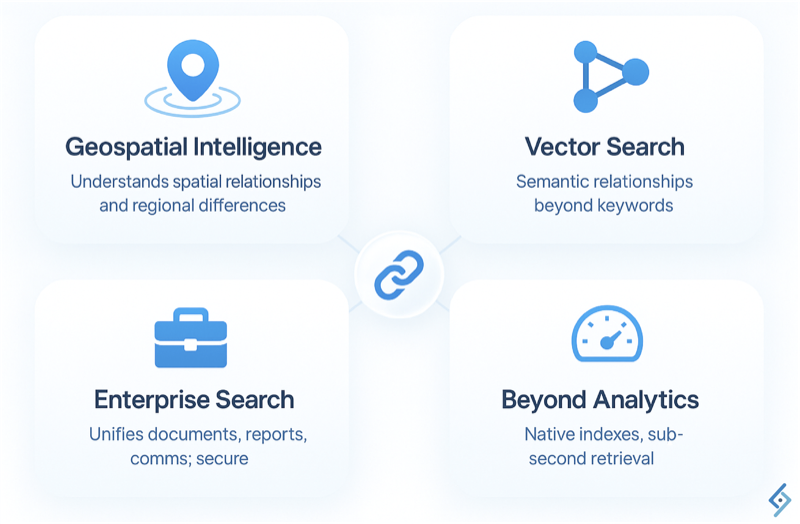
Lucenia searches data in four ways
1. Geospatial Intelligence
Version 0.4.0 enhanced geospatial search because location matters in many industries. Lucenia understands spatial relationships and regional differences that affect your business decisions.
2. Vector Search
Version 0.4.0 improved vector search to find semantic relationships in your data that go beyond keyword matching. AI understands what your domain-specific terms mean and how concepts relate to each other.
3. Enterprise Search
Lucenia handles complex, secure data across sources by gathering all your institutional knowledge—documents, reports, communications—and making them searchable. This differs from a workplace search - within a subset of sources - that helps with daily tasks. Lucenia takes this further with enabling enterprise search that tackles your entire knowledge ecosystem across your organization.
4. Beyond Analytics
Lucenia delivers purpose built search with native indexes, vector search, and relevance ranking that enables sub-second retrieval times. Data Lakes often rely on file formats like Apache Parquet that require inefficient row group scans. In contrast, Lucenia shines with its ability to support real-time updates, dynamic indexing, and advanced scoring to deliver relevant search results at scale.
Data-Driven Decisions and Data Culture
With Lucenia, you make decisions based on facts from your domain, building a data culture where choices have verifiable backing.
Here is a real world example: a retail company uses Lucenia to search sales patterns, customer feedback, and inventory data simultaneously. They spot trends faster, stock the right products, and reduce waste because their AI recommendations are based on their specific business patterns.
In another case, a manufacturing company connects Lucenia to equipment logs, quality reports and maintenance records. Their on-site AI predicts failures accurately; not generic predictions, but predictions based on their equipment, usage patterns, and maintenance history.
Data Analysis for Any Business Size
Lucenia combines AI with your domain's data and works for any size of business from startups to enterprises. Auto-generated code is fast but dangerous—hidden bugs, cache breaks, and security flaws slip into production. Lucenia gives AI the facts it needs so you ship with confidence instead of crossing your fingers.
Lucenia autoscales up and down, adjusting usage to maintain performance with less memory and compute. Small businesses can use AI-driven search without huge infrastructure costs. At the same time, large enterprises benefit from the efficiency gains at scale.
The platform grows with you: Start small with basic search capabilities and expand as your needs evolve. Add vector search when you need semantic understanding, integrate geospatial features when location becomes essential, or scale up enterprise search as your knowledge base grows.
The Bottom Line
Lucenia gives AI the context it needs by pulling from your institutional knowledge and data sources. Generic AI becomes domain-aware, understanding your business as well as your best employees do.
You don't just get answers, you get the correct answers for your business. The kind of answers that consider your specific constraints, respect your unique requirements, and align with your operational reality.
This is the difference between AI that sounds smart and AI that actually helps. The difference between technology that impresses in demos and technology that delivers in production. It is time to make the switch from generic solutions to domain specific intelligence that drives real business value.