Edge Computing in Theme Parks: A Use Case for Lucenia

Theme parks present unique challenges when it comes to ensuring guests with the best experience. From the massive numbers of guests to countless experiences and restaurants, theme parks require technology that centralized computing alone struggles to address. Theme parks are an ideal use case for edge computing: with daily visitor counts above 100,000 during peak seasons, and the need for sub-second response times for location-based queries. In this blog, we will look at the benefits of edge computing in theme parks and take advantage of Lucenia's search capabilities.
The Challenge: Scale and Latency in Theme Parks
Theme parks face several major challenges:
- Concurrent load: During peak seasons, guest count can exceed 100,000.
- Location requirements: Queries like "nearest restroom" require precise GPS responses.
- Real-time data needs: Wait times, show schedules, and capacity information change by the second.
- Network congestion: Traditional cellular infrastructure becomes overwhelmed in crowded areas.
- Mission-critical operations: System and application failures directly impact guest experience and park operations.
Lucenia: Built for the Edge
Lucenia's architecture makes it particularly well-suited for edge deployment. Several key advantages of Lucenia that make it ideal for use in theme parks include:
- Lightweight Footprint: Lucenia is built and designed to use less memory and compute. These optimizations allow Lucenia to run effectively on resource-constrained hardware at the edge.
- Hybrid Cloud Architecture: Lucenia supports search clusters distributed where you need them. With the ability to run Lucenia on-premises, self-hosted, and in cloud environments, this enables theme parks to balance from edge to cloud resources as needed.
- Geospatial Capabilities: Lucenia features advanced geospatial search capabilities with powerful Coordinate Reference System (CRS) functionality. CRS enables precise location-based queries critical for navigation within theme parks. Guest experience is vastly improved by precise navigation and avoiding congestion around the park.
Computing Infrastructure
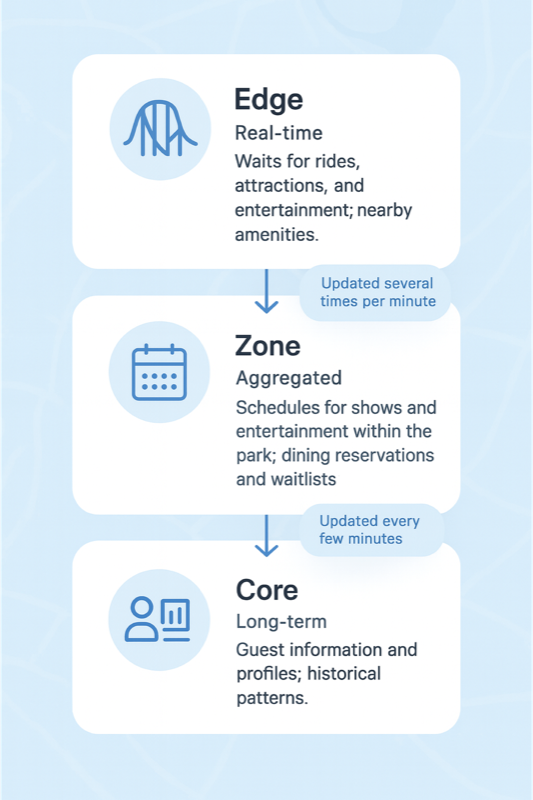
Here we take advantage of a tiered node approach, where smaller nodes at the edge quickly process data. Data can be kept local and transmit only what is necessary to larger data centers further from the edge.
Edge Nodes
- Massive numbers of edge nodes throughout the parks.
- Handle location-based queries and cache data that is used frequently.
Zone Nodes
- Located in each main park area. For example, within a theme park there are separate areas such as Space Land and Animal Land.
- More powerful hardware.
- Aggregate data from edge nodes within a zone, and handle zone related queries.
Central Infrastructure
- Main data center.
- Handle park-wide operations, and store historical data.
Data Distribution
Here we take advantage of Lucenia to store and distribute data based on particular needs; for example, a guest requires a quick answer to a wait time on rides to decide where to head next.
Implementation Benefits
Utilizing Lucenia to implement edge computing at a theme park has several benefits.
- Reduced Latency: The information needed by guests is at their fingertips. Processing at the edge reduces response times to the information they need most.
- Improved Performance: Processing queries locally reduces network traffic and produces a faster response.
- Resilience: Edge nodes continue to operate on local data and maintain functionality during network outages. Local area networks allow for operations at the lowest level to continue to operate as you switch between edge nodes at different parts of the park.
- Cost Reduction: Reduced costs in compute and data access.
Further Enhancements - Predictive Caching
Taking historical data into account, Lucenia can be used to cache important information when it is needed most. Before the lunchtime rush for wait times at restaurants, restaurant data is cached and ready to go for queries. When rain is predicted, indoor attraction information can be cached so families can quickly make it inside to keep dry and enjoy a show. Finally, update and cache information related to transportation for the late night exit after the fireworks show.
Security Considerations
With FIPS 140-2/3 compliant security, Lucenia provides enterprise-grade security essential for handling guest data. Edge processing also enhances privacy by ensuring data is local, only where it is needed; this ensures data is kept local and respects guests' privacy wishes.
Future Considerations
As theme parks continue to grow and evolve with technologies, edge computing will continue to be critical to operations and guest experience. Lucenia's small footprint, and low compute requirements enhance this need for only running what is required at the edge in resource-constrained environments. Take a look at how Lucenia can enhance your edge computing needs, theme parks and beyond.