Meaning-Based Retrieval: Your Vector Search Doesn't Understand the Question

You know the email exists. You are certain of it.
You search for contract renewal and nothing comes back, because the message you are thinking of says "happy to keep things going for another year on the same terms," and never uses either word.
So you try again. And again. Eventually you find it, or you give up and assume you imagined it.
Nothing told you which. No error, no warning, and no way to tell "it isn't there" from "you didn't happen to use their words." The search returned results. They looked fine.
Everyone has had that afternoon. It is also, precisely, what happens inside the search behind your company's documents, your case files and your AI assistant, at a scale where nobody is sitting there knowing the answer exists, so nobody ever notices it did not come back.
That failure has a name in every vendor's marketing: retrieval that understands. It finds what you meant, not what you typed. It is the most confident claim in enterprise software, and almost nobody publishes the test.
We built the thing that claim describes, and we call it meaning-based retrieval. Before explaining what it is, it is worth showing that the problem is real, because the entire industry insists it has already been solved.
It hasn't. The test that shows it takes about a minute, runs on whichever embedding model you already pay for, and every number it returned is below.
The test
This is not a benchmark, it is something you can check before lunch. We used the most over-taught example in the language so that anybody can verify the right answer at a glance:
Pavlov's dog drooled when he heard a bell
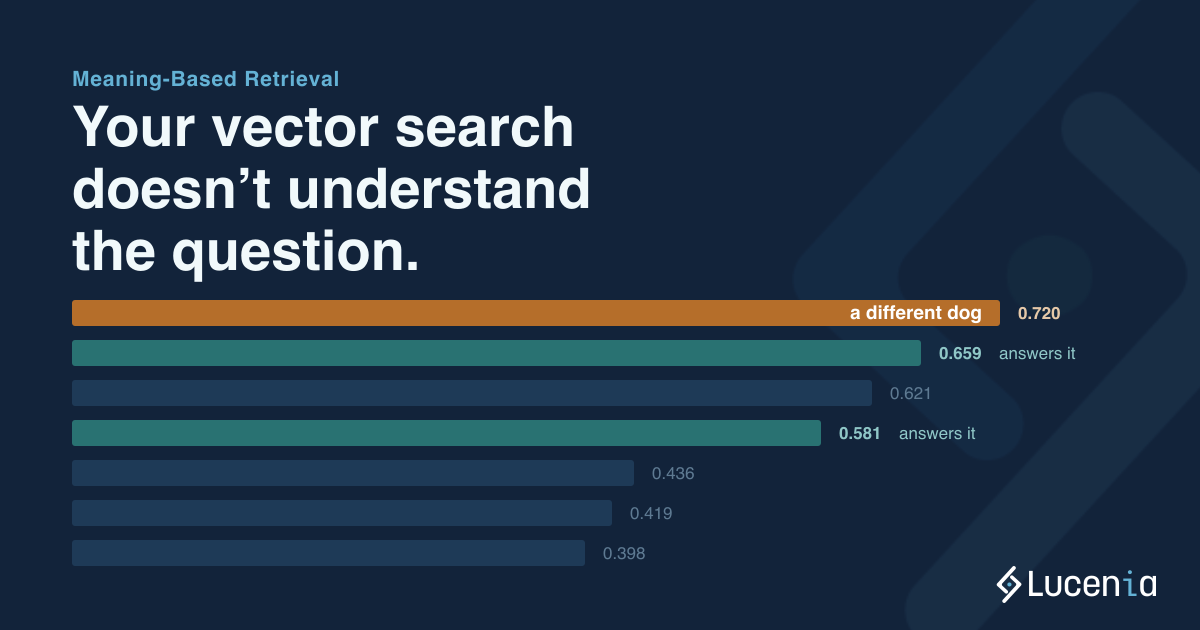
Seven documents went in against that question. Two of them answer it: one paraphrased so it repeats none of the question's words, one in the clinical language a physiologist would use. The other five are about other dogs, other bells, other drooling, and several use exactly the words that were typed.
We ran it against nine embedding configurations across three vendors, and published every number.
The listing below is the model that did worst on this test: OpenAI's text-embedding-3-large,
the most capable embedding model OpenAI sells. Cosine similarity, all eight strings
embedded in one request. The other eight configurations follow further down.
Scores are given to three decimals because OpenAI's values drift in the fourth between calls. The ordering does not. Titan's are stable to four, and reproduce exactly.
Those seven were written to make the vocabulary mismatch explicit. That is the point of the test, and it is what any production system meets the moment two people describe one thing differently. The scores are whatever the model returned: nothing tuned, no run discarded.
1.  0.720   The dog heard a bell on the porch and drooled over his dinner
            bowl.

2.  0.659   Pavlov owned a canine. It experienced an increase in saliva
            production in one particular experiment. In this situation the
            owner tolled the apparatus.                                    ← relevant

3.  0.621   My dog drools whenever the doorbell rings, he thinks it means
            visitors.

4.  0.581   The physiologist paired an auditory stimulus with feeding until
            the animal produced saliva on hearing the tone alone.          ← relevant

5.  0.436   Church bells rang across the village while a stray dog wandered
            the square.

6.  0.419   Drooling in dogs can indicate dental disease and should be
            checked by a vet.

7.  0.398   A bell was mounted above the shop door so the owner heard every
            customer.
The top result is one of the five. Not subtly wrong: a note about somebody's pet on a porch, waiting for its dinner. The paraphrase, which shares not one word with the question, is second. The physiologist's description is fourth, below a dog reacting to a doorbell.
Cut that list at three, which is what a production system does, and you keep two documents about other people's dogs and throw away the physiologist.
To be fair to the technique: this is the worst of the nine, and on most of the others the paraphrase does come first. Anyone who tells you semantic search simply fails this test has not run it. Here is Titan v2, where it wins.

It wins by 0.04. Four hundredths of a point between the right answer and a sentence about a completely different dog. And the second relevant document still lands fifth of seven, below the doorbell and below a veterinary page about dental disease. Cutting at three loses it here too.
That is the pattern across every model we tried. Either the right document is not first, or it is first by a margin too thin to mean anything.
"You picked a weak model"
It is the first thing anyone says, so we ran it across nine embedding configurations from three major vendors.
| model | where the two relevant documents ranked | margin between #1 and #2 |
|---|---|---|
| Titan v2, 1024d | 1st and 5th | 0.0410 |
| Titan v2, 512d | 1st and 5th | 0.0392 |
| Titan v1, 1536d | 1st and 5th | 0.0433 |
| Titan G1 | 1st and 5th | 0.0433 |
OpenAI text-embedding-3-small | 1st and 4th | 0.0089 |
OpenAI text-embedding-3-large | 2nd and 4th | 0.0610 |
Cohere embed-v4 | 1st and 4th | 0.0462 |
Cohere embed-english-v3 | 2nd and 4th | 0.0023 |
Cohere embed-multilingual-v3 | 3rd and 5th | 0.0050 |

Three of the nine ranked a decoy first, and not the weak ones.
The Cohere rows deserve a note, because they answer the sharpest objection to this whole test.
Cohere embeddings are asymmetric: queries and documents are encoded differently, through
search_query and search_document, precisely so that a short question and a long passage can be
compared properly. It is the design most often offered as the answer to vocabulary mismatch, and
we used it exactly as intended.
It did not help. embed-english-v3 puts the wrong dog first, ahead of the paraphrase by two
thousandths of a point. embed-multilingual-v3 puts two decoys above the right answer.
The pattern across the table is the thing to take away. The stronger model did not fix the
problem. It reordered it. Where the right document does come first, the margin ranges from four
hundredths down to 3-small's nine thousandths, which is not a margin but a rounding error
that happened to land your way.
Three vendors, two generations, three embedding sizes, symmetric and asymmetric encoding. This is not an artifact of a model, a vendor, or a setting.
Margins are shown only to indicate separation within each model, and should not be compared across models: every model has its own score distribution.
If your search is a product recommendation, that margin is a shrug. If it is a literature review a regulator will audit, a legal hold, or an analyst asking what your exposure is, that margin decides whether the document surfaces or nobody ever sees it. And when it does not surface, nothing tells you. There is no error. The answer simply looks complete.
What is actually being measured
The interesting part of that result is not that the models failed. It is that most of them succeeded at the hard part.
Look at the paraphrase again. Pavlov owned a canine. It experienced an increase in saliva production. The owner tolled the apparatus. It shares not one word with the question, and six of the nine configurations still ranked it first. Those models have learned that a canine is a dog, that saliva production is drooling, that tolling an apparatus makes a sound. That is real semantic capability and it is not in dispute here.
The failure is narrower, and more interesting than "embeddings do not understand language."
Dog on a porch and Pavlov's dog share their entire vocabulary, so they land close together even though one is a landmark of experimental psychology and the other is a pet waiting for its dinner. A model can know a great deal about what those words mean and still put them next to each other, because what it computes is proximity, not membership.
Similarity is a ranking function. Meaning is a membership test.
Cosine similarity gives you a relative geometric distance. It does not tell you whether a document satisfies what was asked, and no amount of additional semantic capability in the embedding turns the first thing into the second. Dense retrieval is not fake and it is not failing at its job. It answers which documents most resemble this query, and it answers it well. The question a search actually needs answered is which documents belong in the answer set. Those are different questions.
That is not a defect in a particular model, and it is not fixed by a bigger one. It is what the technique measures.
Everyone ships a correction. That is the tell.
The industry knows this gap exists. Look at what each vendor built to cover it, not at their marketing, at their feature list.
Elastic ships a reranking retriever and its own rerank model, alongside ELSER for term expansion and synonym sets somebody maintains by hand. OpenSearch ships a rerank processor in the search pipeline. Vespa, technically the most capable of them, documents cross-encoder reranking and phased ranking you wire into a ranking profile. Snowflake Cortex Search and Databricks Vector Search both put a reranking stage on top of hybrid retrieval. Pinecone, Weaviate and Qdrant ship hosted rerankers. Even MongoDB Atlas and pgvector, which are not search products at all, document reranking as the recommended pattern. And turbopuffer, the newest and most deliberately minimal of them, ships reciprocal rank fusion server-side and points you at Cohere or Voyage for anything past it.
Eleven vendors, one architecture, and it is checkable from their own documentation rather than ours.
None of this is incompetence, and none of it is a workaround. A cheap recall stage followed by an expensive precision stage is sound engineering, and rerankers genuinely do improve precision. Each of those teams built the best available answer to the problem as the industry framed it: retrieve on similarity, then improve the ordering afterwards. The framing is what we disagree with.
Because every one of those stages has the same structural limit, and it is not a matter of opinion:
Reranking is an effective precision stage. But it can only improve the ordering of documents the retrieval stage actually found. In the listing above, the physiologist paper sits at position four. Retrieve the top three, as a production RAG pipeline does, and no reranker on earth recovers it, because it was never fetched.
Your recall ceiling is fixed by what retrieval returns. This is the sentence that matters. Whatever that pass missed is missed permanently, and every stage downstream (the cross-encoder, the LLM, the reranker) is working inside a set that was already wrong. Precision can be bought later. Recall cannot.
A second store is a second thing that drifts. Graph RAG buys symbolic matching at the cost of a knowledge graph built by imperfect extraction, maintained against a corpus that changes, and silently diverging from it whenever it is not. Two systems, and you hope they agree.
Rank fusion cannot invent a rank. The cheapest correction, and the most widely shipped, is
fusing a keyword list with a vector list. It is worth doing the arithmetic on, because the
arithmetic is published. turbopuffer scores each document as weight / (rank_constant + rank),
summed across the sub-queries, with the rank constant defaulting to 60. Over seven documents that
puts first place about ten percent ahead of last, which means the formula rewards appearing in
both lists far more than it rewards being right in either. Now apply it to this question. The
paraphrase shares not one word with what was asked, so the keyword list is precisely where it does
not appear, and anything appearing in both lists outscores it no matter what the vector list
thought. For the single document that required understanding the question, the second opinion
contributes nothing and the fusion is worse than the vector list alone. And none of this is
novel, ours included: we have shipped reciprocal rank fusion for years. That is rather the point.
It is commodity arithmetic, everybody has it, and it is not where the problem lives.
Query expansion is a guess. Rewriting the query to add classical conditioning, Pavlovian response, canine salivation works when the guess is right. It is an inference about the wording of a document nobody has read yet, paid for with a model round-trip on every single query, at every scale, forever.
What this costs in the real world
Three consequences, and none of them are theoretical.
You pay for the correction on every query. A reranking pass is a second model invocation per search. At a thousand searches a second that is a second inference fleet, sized and funded, whose entire job is compensating for the first stage. The economics are visible in anybody's cloud bill.
Latency is additive. Retrieve, then rerank, then generate. Each stage waits for the last. Teams tune the candidate set down to keep the reranker fast, which shrinks the very pool that recall depends on, and makes the miss more likely, not less.
And when it fails, it fails silently. This is the one that should worry you. A missed document produces no error, no warning, and no gap in the results. The answer looks complete. In the test above, a system that returned the top three would have handed back three confident, plausible documents and lost the physiologist, and nobody downstream would ever have known to ask.
Somebody shopping for a jacket will scroll. But "the answer looked complete" is not something a regulator accepts, or a court, or an analyst asked what your exposure is, or a medical examiner comparing a description of remains against five thousand missing-person reports. Those are the searches where the document you did not retrieve is the one that mattered, and where nothing in the result will ever tell you it existed.
Meaning-based retrieval
Every architecture in that list makes the same choice: retrieve on similarity, then correct. The correction is where all the engineering has gone: better rerankers, cheaper cross-encoders, smarter query rewriting. All of it sits downstream of a decision that was already made by a distance calculation.
Lucenia moves meaning to the retrieval step itself. Not a stage in front of it, not a stage behind it, not a second database beside it. The step that decides what comes back at all is the step that understands what was asked.
Ask once, and it answers the same way whether the author wrote dog or canine, drooled or produced saliva, bell or apparatus. No reranking pass to fund on every query. No second store to keep in step with the first. No guessing which words a document nobody has read yet might contain.
The same seven documents
It is a fair question what our own answer looks like on the test we just used to criticise everybody else, and it is the last row of the chart above. Same seven documents, no ranking involved.
Asked for an animal, a bodily response and a sound, which is what the question is about rather than the words it happened to use, four documents come back. Both of the right ones, plus two about a pet on a porch and a dog at a doorbell, because those genuinely do describe an animal salivating at a sound. That is not a failure; it is an honest answer to a broad question.
Narrow it to the same three things occurring inside a study, and the answer is two documents:
Pavlov owned a canine. It experienced an increase in saliva production…      ← relevant
The physiologist paired an auditory stimulus with feeding until…            ← relevant
Two of seven. Both correct. Nothing else.
Notice what you are not asked to do with that result.
Every model in the table hands back all seven documents, sorted by resemblance, and leaves the real decision to you: how far down do you read? Take three and you get two documents about other people's dogs. Take five and you finally have both right answers, along with a veterinary page. There is no number in the output that tells you where to stop, which is why every production system picks an arbitrary cut-off and lives with it.
The last row is not a better-sorted list. It is a different kind of answer: these two documents are about what you asked, and the other five are not. No score to interpret, no cut-off to choose, nothing to tune.
And this is not free. Those documents carry a record of what they are about, and something had to put it there. That is the work this approach asks for, and it is the honest trade: meaning is represented before retrieval rather than inferred from a distance at query time.

That is the whole difference, and it is a difference in kind rather than degree. A better reranker gives you a better ordering of the documents similarity already found. Meaning-based retrieval changes which documents are found. Recall is decided at retrieval, and retrieval is the one place nobody else has touched.
We believe Lucenia is the first general-purpose search engine to ship meaning-based retrieval as a native retrieval primitive, and we expect that to be temporary. The idea is too obviously right to stay ours alone. What is not temporary is that the industry has spent three years building increasingly elaborate machinery to compensate for a retrieval step nobody was willing to change. That machinery is now the moat around a design decision, and it is the wrong one.
Run it yourself
The test is at the top of this page. Run it against whatever you have in production.
The number to watch is not whether the paraphrase comes first, which it usually does. It is how little sits between it and a document about somebody else's dog. Then ask what happens to that margin when the corpus is ten million documents instead of seven, and nobody in the room knows what the right answer was.
Curious what this looks like on real records? Try Lucenia, or talk to us about what you are searching.