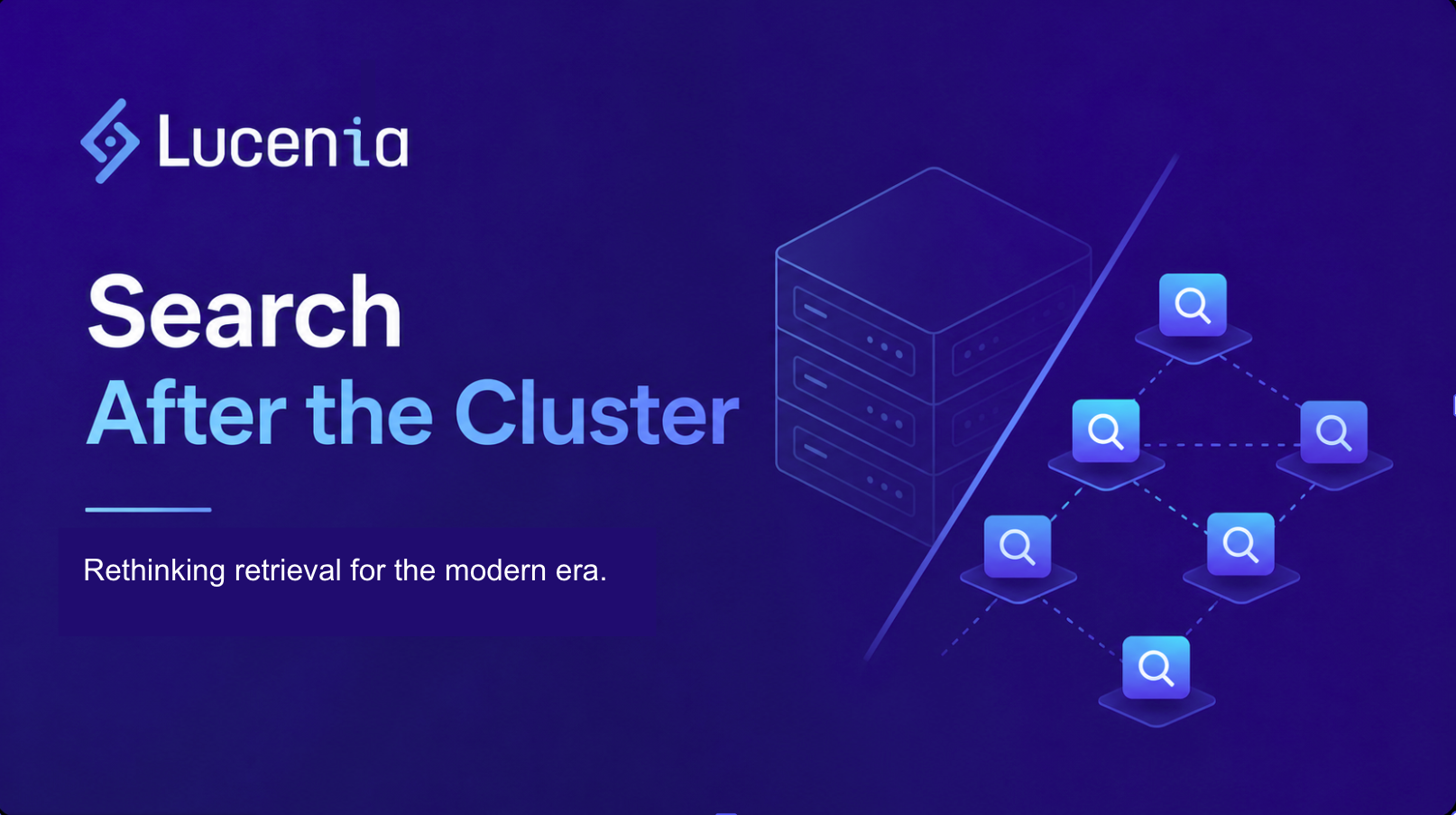
Search After the Cluster

Why the next reinvention of search isn't operational; it's architectural.
The search industry has spent the last decade trying to make centralized search cheaper.
We think the next era is about making centralized search unnecessary.
That belief has shaped nearly every architectural decision we've made since founding Lucenia, and it starts from an important question the industry has mostly stopped asking: what if the architecture itself is wrong? Not the features. Not the deployment model. The architecture.
Every so often an industry reaches a point where incremental improvements stop mattering. Another feature doesn't change the trajectory. Another managed service doesn't change the shape of the thing. The only way forward is to revisit the assumptions that got you here. We believe search reached that point — a long time ago.
Four eras
It helps to remember how we got here. I've had the unusual privilege of watching search evolve from several seats — reinventing numeric and geospatial search in Apache Lucene, building geo and vector search into Elasticsearch, creating OpenSearch, working on search inside Amazon, and now building Lucenia. From every one before Lucenia, the same pattern repeats. Search has moved through three eras, and we're now entering a fourth.
Era 1 — Information Retrieval. Can we search a collection of documents? Lucene's question: given a data corpus, find the relevant thing.
Era 2 — Distributed Search. Can we search billions of documents? The answer was the cluster — shard the index across many machines, replicate for durability, coordinate centrally. For twenty years, "scaling search" meant "building a bigger cluster."
Era 3 — AI Retrieval. Can we retrieve context? Embeddings, vectors, hybrid search, RAG, agents. A genuine shift in what search is for — from matching keywords to retrieving meaning.
But notice what didn't change: we kept the Era 2 architecture. We bolted vectors onto the same centralized cluster, called it a "revolution," and then quickly said "scale to zero" is what makes it affordable. Enter the autoscaling arms race.
Era 4 — __________. Search no longer means bringing context to a cluster.
The strange thing about search in 2026
Skim the recent announcements from any major search platform and they read alike: vector search, hybrid search, RAG, agentic AI, GPU inference, connectors — and, increasingly, a very particular set of infrastructure promises.
"Scale to zero."
"Scale up in seconds" — never mind what near-real-time was supposed to mean.
"20× faster autoscaling."
"Decoupled compute and storage."
"Purpose-built for agentic workloads."
Every one is a real marketing message — the phrasing even happens to come from a recent, recycled campaign, but it could be any of us; the whole industry speaks this language now. Every one is a genuine engineering achievement that we celebrate in our echo chamber. And every one is about the same thing: making a centralized architecture fractionally cheaper to operate.
So here is the question worth sitting with: why is every innovation in search suddenly about infrastructure?
We optimized the server, not the search
Because we've spent twenty years optimizing servers instead of search. Serverless. Scale-to-zero. Decoupled storage. Autoscaling — and, even as I write this, the newest entry on the list: event-driven autoscaling wired to KEDA, so the cluster can breathe with its own query load. These are incremental operational improvements. They make the cluster cheaper to run. They do not change what the cluster is. Every new arrival is another lever on the same machine.
And there's a tell buried in the pitch:
If the headline innovation is the ability to turn the servers off, the architecture has already admitted it's too expensive to leave on.
The justification is always cost: eliminate idle compute, pay only for what you use, separate compute from storage, save sixty percent. But for many large-scale deployments, that solves the wrong cost function. The dominant costs aren't idle CPUs. They are the costs of centralization itself — copying data into the engine, moving it between tiers, replicating it across zones, rebuilding indexes, keeping dozens of copies synchronized, operating one giant cluster whose failure domain is the entire system. Those are architectural costs, and no amount of serverless engineering touches them.
The bill isn't high because your application runs a long time. It's high because the architecture asks you to move the world into one place, replicate it across many, and keep it all in sync.
Look closely at "decoupled compute and storage," the innovation everyone is proudest of. Compute becomes separate from the data, so it can theoretically come and go. Okay. But storage is still centralized. Cluster state is centralized. The write-ahead logs — transaction logs, commit logs, whatever you want to call them — are centralized. The indexes get rebranded as "remote-backed," but they're still centralized. The failure domain is still centralized. Ownership is still centralized. Costs continue to rise. The architecture hasn't changed — only the billing model has. And it hasn't changed for a reason: once storage is the permanent, centralized layer, everything above it is shaped by one provider's storage service. The optimization is real. It is also only meaningful inside one operational model. That isn't a conspiracy; it's what happens when you optimize the deployment layer instead of the architecture.
There's even a cost the slide never mentions. Scale a search node to zero and the next query has to hydrate its index from object storage before it can answer — the very object storage the architecture pushed everything into. Scale-to-zero and low-latency retrieval pull against each other; they inevitably introduce trade-offs around cold-start latency and state hydration. You buy the idle savings with the first query's wait.
You can see the same instinct in how these systems grew. Faced with new demands — vectors, then analytics, then agents — the centralized cluster answered by absorbing them: a vector path here, an analytics path there, each grafted onto an index designed for neither. It's an understandable response. It's also how a search engine becomes a system that does a great many things and none of them cleanly. When the architecture can't change because the revenue model won't allow it, the only move left is to add.
What AI actually broke
The cloud-database era taught a generation that everything belongs in one giant database. Search inherited that instinct wholesale: bring all your data here, index it, replicate it, back it up, pay forever to keep it in sync.
AI doesn't work that way. AI doesn't need one giant index. It needs contextual retrieval — the right fragment of context, at the moment of the question. And context doesn't live in one place. It lives across clouds, edge devices, private datacenters, sovereign environments, laptops, and increasingly the agents themselves.
For twenty years we assumed search meant collecting all our data into one massive cluster. That made sense when search was documents and — however much we stretched the definition — logs. It makes far less sense when context is spread across everything.
So the question stops being "how do we build a bigger cluster?" and becomes the one almost nobody is asking: why are we still building giant clusters at all?
Distributed was never decentralized
Here is the distinction that changes the mold — and the one the industry has quietly conflated for two decades.
For twenty years we've called systems "distributed" because they spread one logical cluster across many machines. But when it relies on an orchestrated central state, that's still centralization. One index, one owner, one failure domain, one control plane — simply smeared across more hardware, and more line items the hyperscaler can roll into your cloud bill. Distributing a cluster makes it bigger. It doesn't make it decentralized.
Decentralization isn't about spreading a cluster farther. It's about eliminating the assumption that there needs to be one cluster at all.
Once you see that line, the rest of the argument becomes hard to unsee. Every serverless improvement, every autoscaling breakthrough, every tiered-storage trick is an effort to make the one cluster cheaper. None of them question whether the one cluster should exist.
Search gravity
There's a concept from the data world called data gravity: data attracts services, it's expensive to move, so systems accumulate around it. Search has fought data gravity for two decades — every architecture says bring your data to the search engine, copy it, index it, replicate it, synchronize it, forever.
The future inverts it. Instead of pulling the data to the search engine, you push the search engine to the data.
Search should follow the data — not the other way around.
That single move changes the cost function completely. No central petabyte cluster, because there is no central anything. No migration, because nothing moves. No ingestion tax, no synchronization tax, no replication tax — and no scale-to-zero, because it's unnecessary; nothing needed scaling in the first place. When retrieval runs where the data already lives, each index is already small. You don't turn the cluster off. There is no cluster.
Serverless is an attempt to make you think centralized search is affordable — while the hyperscalers quietly shift the costs around. Decentralization makes centralized search unnecessary.
The new era
Which brings us back to Era 4 — the one we left unnamed.
Decentralized Retrieval.
Search no longer means bringing context to a cluster. It means bringing retrieval to wherever context already lives. This is the era the whole industry is standing in front of right now, and doesn't even realize it.
Over the next few years, we'll stop talking about search clusters and start talking about retrieval fabrics — retrieval as a property of the environment rather than a system you stand up beside it. The measure of a great search system will invert. Not the size of your cluster, but how little infrastructure you need for retrieval to simply happen, wherever your data and your agents already are. Indexes become small. Retrieval becomes decentralized. Ownership becomes distributed. Infrastructure becomes invisible.
Where we've been going all along
None of this is a pivot for us. It's the reason we started. Since the day we founded Lucenia, we've believed the future of search would not be defined by bigger clusters, faster provisioning, or another managed service. We believed it would be defined by bringing retrieval to where data already lives — sovereign, private, at the edge, air-gapped, or spread across every cloud at once. Deploy-anywhere, autonomous on-demand scaling, verifiable and tamper-resistant retrieval, and now decentralized retrieval itself are not separate features. They are pieces of the same idea we've been building toward from the beginning.
Lucenia didn't set out to build a better search cluster.
Lucenia set out to build a future where search clusters become increasingly unnecessary.
Over the coming months we'll share much more about what we've built — and about the full product we've been quietly working toward: a way to bring sovereign, verifiable retrieval directly to your data, on any infrastructure you choose, without ever handing that data to someone else's cluster.
If you want to go deeper on the future of search for contextual AI — from the data structures underneath retrieval to the distributed systems that make it work at scale — I'm writing about all of it in my upcoming O'Reilly book, Scaling Search and Retrieval for Contextual AI: From Data Structures to Distributed Systems.
The reinvention that isn't operational
Google reinvented search at internet scale. Lucene, and the platforms built on it, reinvented search for applications. The cloud providers reinvented how search is operated. Each of those shifts began the same way: someone challenged an assumption everyone else had accepted.
We believe the next assumption to fall is that retrieval requires a centralized cluster at all.
When it does, search won't disappear. It will simply become part of the underlying fabric of every system.